

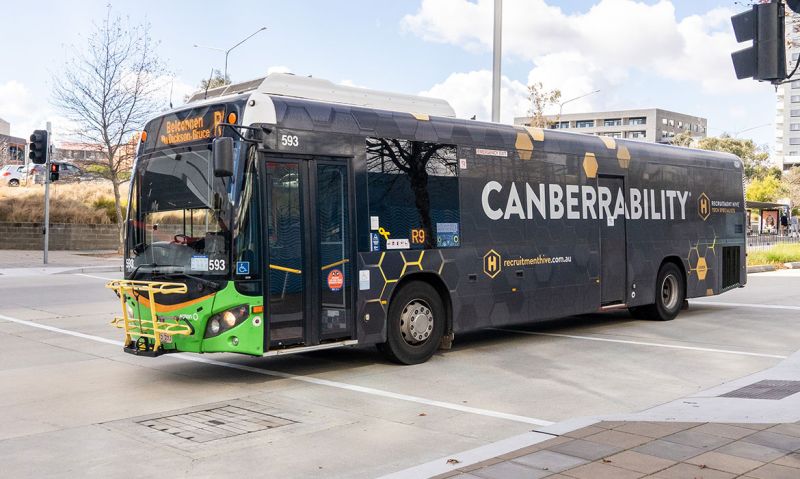
If you’ve ever tried to read a bus ad while changing lanes on Parramatta Road or crawling through the CBD at peak hour, you already know the truth: speed changes everything. The same creative can look brilliant parked at a stop and completely invisible when it’s moving at 70 km/h past a set of traffic lights.
A good bus campaign doesn’t just “look nice”. It’s built for the way people actually see it: quick glances, shifting angles, distractions everywhere, and wildly different viewing times depending on where the bus is travelling.
Below is a practical guide to designing for three real-world situations: suburban corridors, CBD crawl, and bus stops.
Suburban corridors: 50–80 km/h, quick glances, big wins (if you keep it simple)
On suburban arterials and connector roads, people usually see your ad while doing something else: driving, turning, checking mirrors, watching pedestrians, scanning signage. You’re working with two to three seconds of attention, sometimes less.
In this environment, clarity beats cleverness.
What works best:
- One message. One idea. Not three offers, not a paragraph.
- Short copy. Think a punchy line and a brand name — that’s it.
- High contrast. Light text on dark background (or vice versa). Don’t rely on subtle colour gradients.
- A strong “shape” people recognise instantly: bold logo placement, a clear hero image, and a clean layout.
If your ad needs explaining, it won’t land here. The best suburban Bus Advertising should feel almost too simple when you’re designing them — that’s usually a good sign.
CBD crawl: slow traffic, repeated exposure, more room to persuade
City centres are a different beast. Buses stop, start, pull into bays, wait at lights, and move through dense foot traffic. People see the same bus multiple times in a short radius — from different angles and distances.
That repeat viewing means you can add a little more information, but only if you structure bus advertising Sydney properly.
What works best:
- Layered messaging. A headline people get in one second, plus a supporting line they can read if they’ve got time.
- Directional cues. Arrows, “2 mins away”, suburbs, or simple location-based prompts can work well in city settings.
- A clear CTA, but not clutter. “Book online”, “Visit today”, “Search X” — choose one.
- Design for angles. In the CBD, people view from sidewalks, across intersections, from behind glass, or from a bus stop bench. Keep key content away from edges and seams.
This is also where context matters. If you are to advertise on bus targeting Sydney commuters and foot traffic hotspots, it helps to plan specifically for that environment.
Bus stops and shelters: the longest viewing time (and your chance to be detailed)
A moving bus is a blur. A bus shelter isn’t. When someone is waiting, they’ve got time, they’re stationary, and they’re far more likely to read properly, especially if your ad is at eye level.
This is where you can use detail within reason.
What works best:
- Readable typography. Bigger text than you think, with generous spacing.
- Practical information. Opening hours, suburb/service area, clear offer terms, a simple URL.
- Human proof. Reviews, “trusted by locals”, awards, or a short testimonial line can work nicely here.
- A QR code only if it’s easy. It needs a clear reason to scan and a landing page built for phones.
If you’re comparing options and budgeting for waiting-area placements, you’ll want to look closely at Bus Shelter Advertising rates Sydney.
The viewing angle problem (and why “looks good on screen” can fail on the street)
Bus ads are rarely seen straight-on. People see them on curves, at intersections, partially blocked by other vehicles, or through reflections. That’s why fine detail and low-contrast design gets lost fast.
A quick test: shrink your design until it’s the size of a matchbox on your screen. If the headline and brand still read clearly, you’re on the right track.
Another test: stand three metres away from a printed A4 mock-up and glance at it for two seconds. If you can’t repeat the message confidently, simplify.
Match the message to the moment
Here’s the easiest way to think about it:
- Fast road: Make them remember you.
- Slow city: Make them understand you.
- Bus stop: Make them act.
That’s it. Three environments, three goals.
When people try to force one “universal” ad across every placement, they usually end up with creative that’s average everywhere and great nowhere. If you’re investing in a run, it’s worth adapting artwork or at least building variations.
If you’re weighing placements and timing, it’s also smart to ask about Bus Shelter Advertising rates Sydney early so your creative matches the format you can afford.
A simple checklist before you send artwork to print
Before your next campaign goes live, run through this:
- Can the main message be read in two seconds?
- Is there one clear takeaway (not three)?
- Does the brand show up fast — even from the corner of your eye?
- Is the contrast strong enough for bright sun and shade?
- Does the design still work when viewed on an angle?
- If it’s a stop/shelter placement, does it give people a reason to act now?
Bus ads aren’t just about reach; they’re about readability in real life. Design for the speed your audience experiences, and you’ll get far more out of every placement.